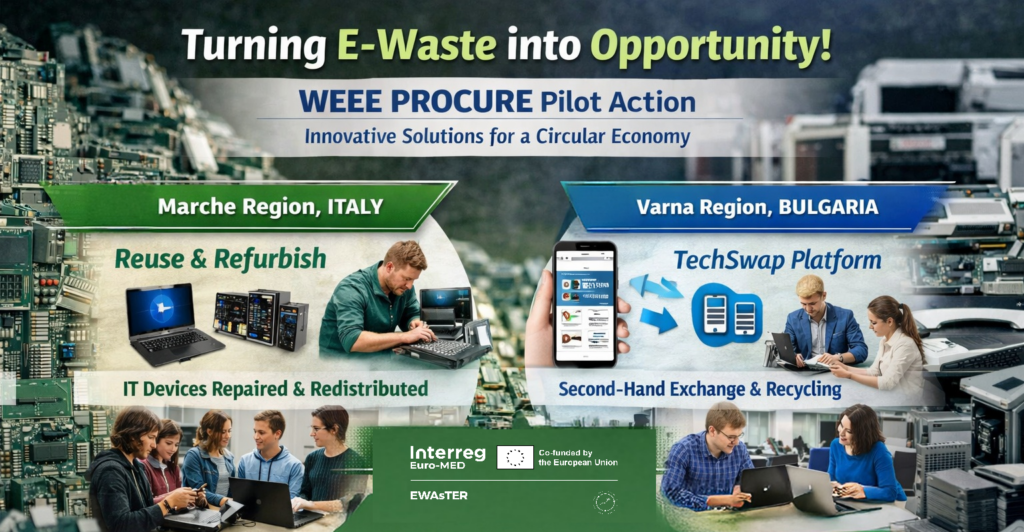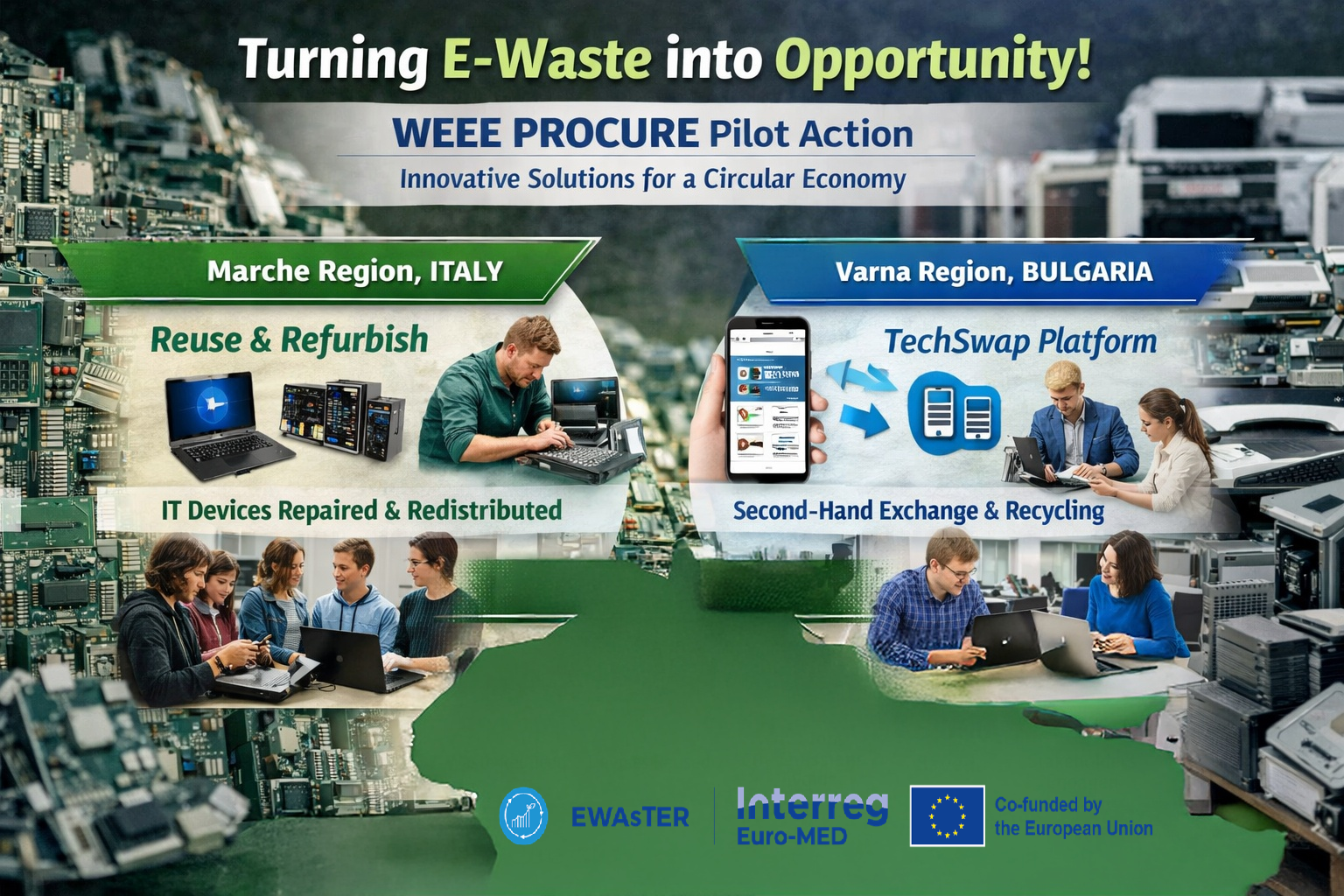

Originally focused on eco-renting IT equipment, the project evolved to meet real-world challenges—leading to practical, locally adapted circular solutions in two regions.
The WEEE PROCURE pilot action, part of the Interreg eWAsTER project, has successfully demonstrated how innovative, practical solutions can transform electronic waste into valuable resources—supporting a greener, more circular economy across Europe. Led by key partners including Union of Bulgarian Black Sea Local Authorities (UBBSLA) and the Marche Region, the initiative tackled one of today’s fastest-growing environmental challenges: waste from electrical and electronic equipment (WEEE).
From Concept to Impact
Originally designed to introduce eco-renting models for IT equipment, the project evolved in response to real-world legal and operational challenges. This model was expected to generate mutual benefits: users would access up-to-date technology without generating electronic waste, while suppliers could develop new business opportunities through maintenance, refurbishment, and resale, thus extending product lifecycles. The pilot was originally structured over a 12-month period, during which partners would work with both demand and supply sides to define a legal and operational framework for eco-innovative procurement and prepare the launch of future tenders outside the project timeframe. The overall objective was to contribute to the transition from a linear to a circular economy in the EEE sector, reducing waste generation and improving resource efficiency.
During implementation, however, the pilot evolved significantly in response to the specific legal, administrative, and operational conditions encountered at regional level. In particular, both the Marche Region and the UBBSLA identified important constraints that limited the feasibility of the eco-renting model, especially within public administration contexts.
In the Marche Region, the assessment highlighted structural and technical challenges related to procurement procedures, data security, and the absence of an organised reuse network. As a result, the pilot shifted towards the development of a circular model based on the reuse and refurbishment of decommissioned IT equipment. The approach is built on a structured system in which devices from public entities are assessed, refurbished through collaboration with reuse centres, professional repairers and technical institutes, and subsequently redistributed to schools, third-sector organisations, and citizens in need. This model not only extends the lifecycle of equipment but also generates social value and supports local circular ecosystems. The pilot has already led to policy-level developments, contributing to the integration of these practices into regional waste prevention strategies.
In parallel, in the Varna region, the UBBSLA conducted an in-depth assessment involving municipalities and key stakeholders. This process revealed that the implementation of eco-renting was not compatible with the current Bulgarian legal framework, particularly due to constraints within public procurement legislation and risks related to ownership, liability, and data management. To ensure the achievement of the project’s objectives, the pilot was adapted to focus on the development of a digital platform facilitating the reuse, exchange, and recycling of EEE. The platform enables public authorities, organisations, businesses, and citizens to exchange second-hand devices, identify equipment for recycling, and interact directly, while fully complying with existing legal requirements.
Despite the different approaches adopted, both pilot experiences converge towards a common outcome: the identification of practical and territorially adapted solutions to promote circularity in the EEE sector. Rather than implementing a single eco-renting model, the project demonstrated that alternative pathways, such as structured reuse systems and digital exchange platforms, can achieve comparable environmental benefits while ensuring feasibility and compliance.
The result? Two powerful, locally adapted solutions that are already delivering measurable environmental, economic, and social benefits.
Two regions, one circular vision
Italy – Reuse & Refurbishment Model
In the Marche Region, public institutions now give a second life to decommissioned IT equipment. Devices are:
- Collected and assessed before becoming waste
- Refurbished by technical institutes and repair networks
- Redistributed to schools, NGOs, and communities in need
This model not only reduces waste but also supports education, builds technical skills, and bridges the digital divide.
Bulgaria – Digital Platform Innovation
In the Varna region, UBBSLA developed an intuitive TechSwap digital platform that enables:
- Exchange of second-hand devices
- Easy access to reuse and recycling options
- Direct interaction between municipalities, businesses, and citizens
The platform provides a simple, scalable, and legally compliant solution for circular economy practices.
Measurable results
The pilot has already delivered strong results across both regions:
- 1,500 kg of e-waste reduced
- 300+ devices assessed for reuse
- Up to 160 devices refurbished or exchanged
- 5 tons of CO₂ emissions avoided
- €5,000 in cost savings for users
- 40+ stakeholders actively engaged
- A Model for Europe’s Circular Future
Despite initial challenges, the WEEE PROCURE pilot proves that flexibility and local adaptation are key to success. Whether through structured reuse systems or digital platforms, the project shows that:
- Circular solutions can work within existing legal frameworks
- Public institutions can lead the transition to sustainable practices
- Collaboration across sectors creates lasting impact
Ensuring long-term impact and transferability
WEEE PROCURE has successfully demonstrated a sustainable and transferable model that can be implemented in other regions facing similar legal or operational constraints. The pilot’s modular design and use of universal elements, such as public ICT stock and existing technical school infrastructure, enable straightforward adaptation in other municipalities and countries.
The initiative’s long-term impact is secured by the integration of these circular practices into regional policy, such as the Marche Region’s Waste Prevention Programme, ensuring that e-waste management becomes a permanent legislative reality. By fostering collaboration across sectors and training the next generation of technicians, the project creates the necessary conditions for scaling up circular economy ecosystems across Europe.
Together, we are turning e-waste into opportunity — for people, for communities, and for the planet.